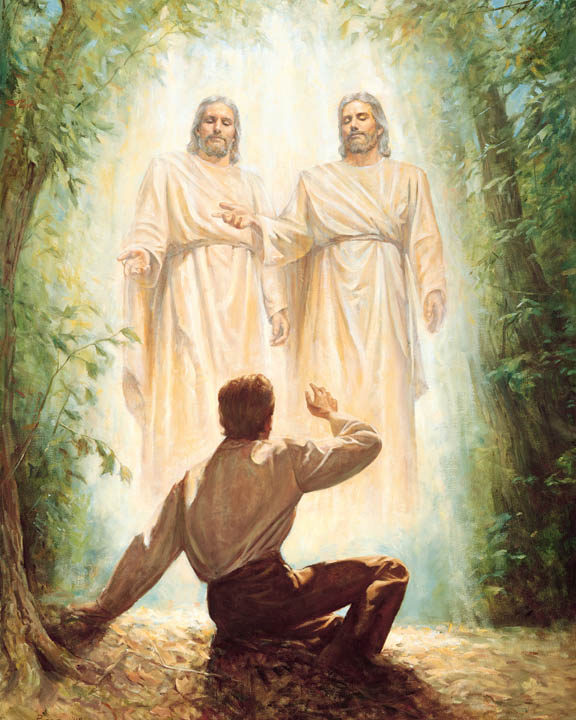
How thankful I am for a young boy who decided to pray. Many people have heard this name but very few have listened intently to his experience. His understanding of the Gospel of Jesus Christ grew with heart felt prayers and a willing to listen. His name is Joseph Smith.
I know that Joseph Smith truly saw God the Father and His Son Jesus Christ. I know he talked with Them. I know that you too can know of this experience if you sincerely pray about it. I know this by the Power of the Holy Ghost. I love this message as it is the beginning of bringing families together for eternity.
Have you ever thought to yourself in a time of need, "O GOD, WHERE ART THOU?" Know you are completely normal. I think at least once in our life we are going to be sitting there thinking this. Many times have I needed help and no one was there. I even felt at times God was not there but in all reality I was just not listening.
Prayer and prophecies written by Joseph Smith the Prophet while he was a prisoner in the jail at Liberty, Missouri, dated 20 March 1839. The Prophet and several companions had been months in prison
"O God, where art thou? And where is the pavilion that covereth thy hiding place?
How long shall thy hand be stayed, and thine eye, yea thy pure eye, behold from the eternal heavens the wrongs of thy people and of thy servants, and thine ear be penetrated with their cries?
Yea, O Lord, how long shall they suffer these wrongs and unlawful oppressions, before thine heart shall be softened toward them, and thy bowels be moved with compassion toward them?
O Lord God Almighty, maker of heaven, earth, and seas, and of all things that in them are, and who controllest and subjectest the devil, and the dark and benighted dominion of Sheol—stretch forth thy hand; let thine eye pierce; let thy pavilion be taken up; let thy hiding place no longer be covered; let thine ear be inclined; let thine heart be softened, and thy bowels moved with compassion toward us.
Let thineanger be kindled against our enemies; and, in the fury of thine heart, with thy sword avenge us of our wrongs.
Remember thy suffering saints, O our God; and thy servants will rejoice in thy name forever."
God responded to him by saying,
"My son, peace be unto thy soul; thine adversity and thine afflictions shall be but a mall moment;
And then, if thou endure it well, God shall exalt thee on high; thou shalt triumph over all thy foes.
Thy friends do stand by thee, and they shall hail thee again with warm hearts and friendly hands.
Thou art not yet as Job; thy friends do not contend against thee, neither charge thee with transgression, as they did Job...."
That is truly words of comfort. Now maybe we don't hear God's voice but we can open the scriptures and read what God says to us. We may not have experiences like this but do know what God is listening to us. He answers our prayers in His due time. It is so hard to work by His time when we think we need everything right now. Thank goodness He sees the big picture and gives everything to us when we truly need it.
Take a minute and think about a time that God has answered your prayer. Did you see the benefit of when He answered it? Did you thank Him? These are important questions especially the second one. If we don't thank God for the things He gives us why should He give us more?
Prayer is so important in our lives.
Using the Supernal Gift of Prayer
Richard G. Scott Of the Quorum of the Twelve Apostles
The Gift of Prayer
Prayer is a supernal gift of our Father in Heaven to every soul. Think of it: the absolute Supreme Being, the most all-knowing, all-seeing, all-powerful personage, encourages you and me, as insignificant as we are, to converse with Him as our Father. Actually, because He knows how desperately we need His guidance, He commands, “Thou shalt pray vocally as well as in thy heart; yea, before the world as well as in secret, in public as well as in private.”
It matters not our circumstance, be we humble or arrogant, poor or rich, free or enslaved, learned or ignorant, loved or forsaken, we can address Him. We need no appointment. Our supplication can be brief or can occupy all the time needed. It can be an extended expression of love and gratitude or an urgent plea for help.
How Should You Pray?
We pray to our Heavenly Father in the sacred name of His Beloved Son, Jesus Christ. Prayer is most effective when we strive to be clean and obedient, with worthy motives, and are willing to do what He asks. Humble, trusting prayer brings direction and peace.
Don’t worry about your clumsily expressed feelings. Just talk to your compassionate, understanding Father. You are His precious child whom He loves perfectly and wants to help. As you pray, recognize that Father in Heaven is near and He is listening.
A key to improved prayer is to learn to ask the right questions. Consider changing from asking for the things you want to honestly seeking what He wants for you. Then as you learn His will, pray that you will be led to have the strength to fulfill it.
Should you ever feel distanced from our Father, it could be for many reasons. Whatever the cause, as you continue to plead for help, He will guide you to do that which will restore your confidence that He is near. Pray even when you have no desire to pray. Sometimes, like a child, you may misbehave and feel you cannot approach your Father with a problem. That is when you most need to pray. Never feel you are too unworthy to pray.
I wonder if we can ever really fathom the immense power of prayer until we encounter an overpowering, urgent problem and realize that we are powerless to resolve it. Then we will turn to our Father in humble recognition of our total dependence on Him. It helps to find a secluded place where our feelings can be vocally expressed as long and as intensely as necessary.
I have done that. Once I had an experience that caused me immense anxiety. It had nothing to do with disobedience or transgression but with a vitally important human relationship. For some time I poured my heart out in urgent prayer. Yet try as I might, I could find no solution, no settling of the powerful stirring within me. I pled for help from that Eternal Father I have come to know and trust completely. I could see no path that would provide the calm that is my blessing generally to enjoy. Sleep overcame me. When I awoke, I was totally at peace. Again I knelt in solemn prayer and asked, “Lord, how is it done?” In my heart, I knew the answer was His love and His concern for me. Such is the power of sincere prayer to a compassionate Father.
How Are Prayers Answered?
Often when we pray for help with a significant matter, Heavenly Father will give us gentle promptings that require us to think, exercise faith, work, at times struggle, then act. It is a step-by-step process that enables us to discern inspired answers.
I have discovered that what sometimes seems an impenetrable barrier to communication is a giant step to be taken in trust. Seldom will you receive a complete response all at once. It will come a piece at a time, in packets, so that you will grow in capacity. As each piece is followed in faith, you will be led to other portions until you have the whole answer. That pattern requires you to exercise faith in our Father’s capacity to respond. While sometimes it’s very hard, it results in significant personal growth.
He will always hear your prayers and will invariably answer them. However, His answers will seldom come while you are on your knees praying, even when you may plead for an immediate response. Rather, He will prompt you in quiet moments when the Spirit can most effectively touch your mind and heart. Hence, you should find periods of quiet time to recognize when you are being instructed and strengthened. His pattern causes you to grow.
President David O. McKay testified, “It is true that the answers to our prayers may not always come as direct and at the time, nor in the manner, we anticipate; but they do come, and at a time and in a manner best for the interests of him who offers the supplication.” Be thankful that sometimes God lets you struggle for a long time before that answer comes. Your character will grow; your faith will increase. There is a relationship between those two: the greater your faith, the stronger your character; and increased character enhances your ability to exercise even greater faith.
On occasion, the Lord will give you an answer before you ask. This can occur when you are unaware of a danger or may be doing the wrong thing, mistakenly trusting that it is correct.
It is so hard when sincere prayer about something you desire very much is not answered the way you want. It is difficult to understand why your exercise of deep and sincere faith from an obedient life does not grant the desired result. The Savior taught, “Whatsoever ye ask the Father in my name it shall be given unto you, that is expedient for you." At times it is difficult to recognize what is best or expedient for you over time. Your life will be easier when you accept that what God does in your life is for your eternal good.
You are asked to look for an answer to your prayers.Obey the Master’s counsel to “study it out in your mind.” Often you will think of a solution; as you seek confirmation that your answer is right, help will come. It may be through your prayers, or as an impression of the Holy Ghost, and at times by the intervention of others." (End Quote)
I LOVE the chances which I have to talk with God. I love being able to tell Him how I am doing. Yea He knows already but He loves hearing from us. It brings great joy to Him to see us humble ourselves before Him. When we are in that situation of praying, "O GOD, WHERE ART THOU?" Just remember He is listening and waiting for us always to come before Him.
What is the Godhead? Who is in the Godhead? There are many false teachings about the Godhead. Well lets clarify the true doctrine of the Godhead.
Donald Q. Cannon, Larry E. Dahl, and John W. Welch say,
The Personal Nature of God and the Godhead
Though most people who believe the Bible accept the idea of a Godhead composed of the Father, Son, and Holy Ghost, Joseph Smith revealed an understanding of the Godhead that differed from the views found in the creeds of his day. The main Christian sects of the nineteenth century taught of “one God in Trinity, and Trinity in Unity, neither confounding the persons: nor dividing the Substance” and of “one only living and true God, … a most pure spirit, invisible, without body, parts, or passions, immutable, immense, eternal, incomprehensible.”Although other churches and individuals held that the Father and the Son are separate entities,Joseph Smith uniquely taught that the Father, Son, and Holy Ghost are three distinct personages, with the Father and the Son having bodies of “flesh and bones as tangible as man’s,” and with the Holy Ghost being a “personage of Spirit.” (D&C 130:22.)
God the Father. The truths about God that Joseph Smith restored are of paramount importance. In 1844, he taught that “it is the first principle of the Gospel to know for a certainty the Character of God, and to know that we may converse with him as one man converses with another.”Ten years earlier, the Lectures on Faith, which Joseph Smith directed and approved, taught that to acquire faith unto salvation one needs a correct idea of God’s character, perfections, and attributes, and that one needs to know that the course of life one is pursuing is according to God’s will.He also added, “If men do not comprehend the character of God, they do not comprehend themselves.”
The Prophet explained that “God himself was once as we are now, and is an exalted man, and sits enthroned in yonder heavens”; that “he was once a man like us; yea, that God himself, the Father of us all, dwelt on an earth, the same as Jesus Christ himself did”; and that he “worked out his kingdom with fear and trembling.”Through the Prophet, we learn that we “are begotten sons and daughters unto God” and that Christ is the Firstborn. (D&C 76:24; see D&C 93:21–22; Heb. 12:7–9.) As God’s children, we may become gods ourselves through Christ’s atonement and the plan of salvation, being joint heirs of Christ of “all that [the] Father hath.” (D&C 84:38; see also Rom. 8:17; D&C 76:58–60; D&C 132:19–21.) Along with these concepts is the concept of divine parents, including an exalted Mother who stands beside God the Father.
The LDS doctrine of Heavenly Father has led one recent commentator to write, “The Mormons espouse a radical, anthropomorphic conception of God that sets them far apart from other religions.”That concept includes the truth that man and woman are created in the image of God. (See Moses 6:9; Gen. 1:27.) These truths draw all men and women into a relationship with God built upon familial love, trust, feelings of self-worth, hope, and humility, all in proper balance.
Jesus Christ. Joseph Smith learned early of the distinctness of Jesus Christ and God the Father. In the Sacred Grove, fourteen-year-old Joseph saw “two Personages, whose brightness and glory defy all description, standing above [him] in the air.” He learned of their relationship when one of the personages declared, “This is My Beloved Son. Hear Him!” (JS—H 1:17; italics in original.) He saw that the Father and the Son were two separate beings. He experienced the fact that a man could actually converse with Jesus Christ “as one man converses with another.” We do not know all that he learned during that marvelous vision; he later testified, “Many other things did he say unto me, which I cannot write at this time.” (JS—H 1:20.)
From his many translationsand revelations from God, the Prophet received much more information about the Savior. While the Bible is full of information about Christ, the knowledge revealed to Joseph Smith affirms, clarifies, and offers even more. The following teachings of the Prophet describe the Lord in the context of history and the plan of salvation.
Premortal existence. Jesus was in the beginning with the Father and was the Father’s firstborn spirit child. (See D&C 93:21; John 17:1, 4–5; Col. 1:15–16.) He volunteered and was chosen, sustained, and foreordained in the premortal existence to be the Savior of the world. (See Ether 3:14; Moses 4:1–4; Abr. 3:22–28; 1 Pet. 1:20.) He created the earth and is thus called the “very Eternal Father of heaven and of earth.” (Mosiah 15:4; see also Mosiah 3:8; Hel. 14:12; John 1:1–3.) He was Jehovah—the God of the Old Testament, the Holy One of Israel. As Jehovah, he “gave the law” of Moses and “covenanted with [his] people Israel.” (3 Ne. 15:5; see also 2 Ne. 25:29; D&C 110:1–4; 1 Cor. 10:1–4.)
Mortal existence. He was the Son of God, the “Only Begotten of the Father” in the flesh. (D&C 76:20–23.) He fulfilled all righteousness by demonstrating his obedience to his Father and by setting an example for the rest of mankind. (See 2 Ne. 31:5–9; Heb. 5:8–9.) In working out the Atonement, Christ took upon himself the sins of all mankind, suffering “more than man can suffer, except it be unto death” (Mosiah 3:7), trembling because of pain and bleeding at every pore (see D&C 19:18; Luke 22:44), so that “he may know according to the flesh how to succor his people according to their infirmities” (Alma 7:12; Heb. 4:8–9). He laid down his life and took it up again. These things he did that we “might not suffer if [we] would repent” (D&C 19:16), and that he might “bring to pass the resurrection of the dead” (2 Ne. 2:8). Because of these things, he is our advocate, pleading our cause before the Father. (See D&C 38:3–5; 1 Jn. 2:1.)
Postmortal existence. Between his death and resurrection, the Savior visited the world of departed spirits. There he taught the righteous and authorized faithful spirits to preach the gospel to all the dead, including the wicked, so that everyone would have the opportunity to accept the full gospel of salvation.He is now exalted and perfected like his Father. (See 3 Ne. 12:48; Acts 7:55.) Ultimately, he will take the role of the Father as the Father will “take a higher exaltation,” and God will be “thus glorified and exalted in the salvation and exaltation of all his children.”
The Holy Ghost. The Bible gives little detail about the personage of the Holy Ghost. The Prophet, however, gave us a number of insights about that spirit being and his office. On several occasions, especially in Nauvoo in 1842–43, the Prophet spoke of the Holy Ghost as a being “in the form of a personage,”as a “spirit without tabernacle,” separate and distinct from the personages of the Father and the Son.According to the George Laub journal, on another occasion Joseph taught that “the Holy Ghost is yet a spiritual body and waiting to take to himself a body.”
Joseph Smith also explained the difference between a testimony from the Holy Ghost and the gift or right to the constant companionship of the Holy Ghost.In translating the Book of Mormon, he unfolded the meaning of the baptism of fire and of the Holy Ghost. (See 2 Ne. 31:13–14; Mosiah 27:24–26; Matt. 3:11.) Speaking to the Saints, Joseph distinguished between the roles of the First Comforter—the Holy Ghost—and the Second Comforter—the Savior himself.(See John 14:15–21.)
In the beginning, Adam, Seth, and other ancient patriarchs knew these truths about the Godhead because the gospel was declared to them “by holy angels sent forth from the presence of God, and by his own voice, and by the gift of the Holy Ghost.” (Moses 5:58.) Joseph Smith testified that prophets such as Isaiah, Ezekiel, John, and Paul were among those taught “face to face,” who had the heavens opened to them, had “the personage of Jesus Christ to attend [them] … from time to time,” and even had the Father manifest himself unto them.
Not only Paul, but also the early Christians understood the true nature of God.For example, they were often charged with abandoning monotheism and worshiping two Gods. They did not deny this. “We reasonably worship Jesus,” wrote Justin Martyr in the second century A.D., “having learned that He is the Son of the true God Himself, and holding Him in second place, and the prophetic spirit in the third.”
With the apostasy and the loss of many plain and precious truths that were once part of the gospel (see 1 Ne. 13:26), the true knowledge of God was lost. The surviving fragments of truth were subsequently interpreted into mystery, and those who continued to believe in the basic truths about God were denounced as heretics. By the fourth century A.D., little remained of mankind’s original understanding of God.
It is not surprising that the true knowledge of God would be one of Satan’s prime targets and one of the first fundamental doctrines to be lost. With the loss of the priesthood held by the original Apostles, the “key of the knowledge of God” (D&C 84:19), or “the fulness of the scriptures” (JST, Luke 11:53), was gone. That key was restored through Joseph Smith.
Also in Acts 7:55-56 we learn about the Godhead. Straight out of the New Testament it says, "But he, being full of the Holy Ghost, looked up stedfastly into heaven, and saw the glory of God, and Jesus standing on the right hand of God,
And said, Behold, I see the heavens opened, and the Son of man standing on the right hand of God."
Here Stephen saw a vision of God the Father with Jesus standing on the right side of Him. That enough proves the Godhead, how they are truly three separate beings. If you still don't acknowledge the true Godhead then get on your knees and with an open mind ask God Himself if this is true. He will manifest by the Holy Ghost. Pay specific attention to the thoughts and feelings that come to you. This will be the only way you can ever know.
I testify that They are three separate beings. I know this by the Power of the Holy Ghost! This is my testimony!
Through Joseph Smith have been restored all the powers, keys, teachings, and ordinances necessary for salvation and exaltation.
Suppose for a moment someone told you these three facts about a New Testament personality and nothing more: first, the Savior said of this man, “O thou of little faith” (Matthew 14:31); second, this man, in a moment of anger, cut off an ear of the high priest’s servant; and third, this man denied knowing who the Savior was on three occasions, even though he had walked with Him daily. If that is all you knew or focused upon, you might have thought this man a scoundrel or a no-good, but in the process you would have failed to come to know one of the greatest men who ever walked the earth: Peter the Apostle.
Similarly, attempts have been made by some to focus upon or magnify some minor weaknesses of the Prophet Joseph Smith, but in that process they too have missed the mark, the man, and his mission. Joseph Smith was the Lord’s anointed to restore Christ’s Church to the earth. When he emerged from the grove of trees, he eventually learned four fundamental truths not then taught by the majority of the contemporary Christian world.
First, he learned that God the Father and His Son, Jesus Christ, are two separate, distinct beings. The Bible confirms Joseph Smith’s discovery. It tells us that the Son submitted His will to the Father (see Matthew 26:42). We are moved by the Savior’s submission and find strength in His example to do likewise, but what would have been the depth and passion of Christ’s submission or the motivational power of that example if the Father and the Son were the same being and in reality the Son was merely following His own will under a different name?
The scriptures give further evidence of this great truth: “For God so loved the world, that he gave his only begotten Son” (John 3:16). A father offering up his only son is the supreme demonstration of love that the human mind and heart can conceive and feel. It is symbolized by the touching story of Abraham and Isaac (see Genesis 22). But if the Father is the same being as the Son, then this sacrifice of all sacrifices is lost, and Abraham is no longer offering up Isaac—Abraham is now offering up Abraham.
The second great truth Joseph Smith discovered was that the Father and the Son have glorified bodies of flesh and bones. Following the Savior’s Resurrection, He appeared to His disciples and said, “Handle me, and see; for a spirit hath not flesh and bones, as ye see me have” (Luke 24:39). Some have suggested this was a temporary physical manifestation and that when He ascended to heaven He shed His body and returned to His spirit form. But the scriptures tell us this was not possible. Paul taught, “Knowing that Christ being raised from the dead dieth no more; death hath no more dominion over him” (Romans 6:9). In other words, once Christ was resurrected, His body could never again be separated from His spirit; otherwise He would suffer death, the very consequence Paul said was no longer possible after His Resurrection.
The third truth that Joseph Smith learned was that God still speaks to man today—that the heavens are not closed. One need but ask three questions, once proposed by President Hugh B. Brown, to arrive at that conclusion (see “The Profile of a Prophet,” Liahona, June 2006, 13; Ensign, June 2006, 37). First, does God love us as much today as He loved the people to whom He spoke in New Testament times? Second, does God have the same power today as He did then? And third, do we need Him as much today as they needed Him anciently? If the answers to those questions are yes and if God is the same yesterday, today, and forever, as the scriptures so declare (see Mormon 9:9), then there is little doubt: God does speak to man today exactly as Joseph Smith testified.
The fourth truth that Joseph Smith learned was that the full and complete Church of Jesus Christ was not then upon the earth. Of course there were good people and some components of the truth, but the Apostle Paul had anciently prophesied that the Second Coming of Christ would not come “except there come a falling away first” (2 Thessalonians 2:3).
Following Joseph Smith’s First Vision, the Restoration of Christ’s Church commenced “line upon line, precept upon precept” (D&C 98:12).
Through Joseph Smith was restored the doctrine of the gospel being preached to the dead in the spirit world to those who did not have a fair chance on earth to hear it (see D&C 128:5–22; see also D&C 138:30–34). This was not the invention of a creative mind; it was the restoration of a biblical truth. Peter had long ago taught, “For this cause was the gospel preached also to them that are dead, that they might be judged according to men in the flesh, but live according to God in the spirit” (1 Peter 4:6). Frederic W. Farrar, the well-known Church of England author and theologian, made the following observation about this teaching of Peter: “Every effort has been made to explain away the plain meaning of this passage. It is one of the most precious passages of Scripture, and it involves no ambiguity. … For if language have any meaning, this language means that Christ, when His Spirit descended into the lower world, proclaimed the message of salvation to the once impenitent dead” (The Early Days of Christianity [1883], 78).
Many teach that there is one heaven and one hell. Joseph Smith restored the truth that there are multiple heavens. Paul spoke of a man who was caught up into the third heaven (see 2 Corinthians 12:2). Could there be a third heaven if there was no second heaven or first heaven?
In many ways the gospel of Jesus Christ is like a 1,000-piece jigsaw puzzle. When Joseph Smith came on the scene, perhaps 100 pieces were in place. Then Joseph Smith came along and put many of the other 900 pieces in place so that people could say, “Oh, now I understand where I came from, why I am here, and where I am going.” As for Joseph Smith’s role in the Restoration, the Lord defined it clearly: “This generation shall have my word through you” (D&C 5:10).
In spite of this flood of restored biblical truths, some honest searchers have commented: “I can accept these doctrines, but what about all those angels and visions Joseph Smith claimed to have? It seems so hard to believe in modern times.”
To those honest searchers, we lovingly respond: “Were there not angels and visions in Christ’s Church in New Testament times? Did not an angel appear to Mary and to Joseph? Did not angels appear to Peter, James, and John on the Mount of Transfiguration? Did not an angel rescue Peter and John from prison? Did not an angel appear to Cornelius, then to Paul before he was shipwrecked and to John on the Isle of Patmos? Did not Peter have a vision of the gospel going to the Gentiles, Paul a vision of the third heaven, John a vision of the latter days, and Stephen a vision of the Father and Son?”
Yes, Joseph Smith did see angels and visions—because he was the instrument in God’s hands to restore the same Church of Jesus Christ as existed in primitive times—all of its powers as well as all of its doctrines.
Yet sorrowfully, on occasion, some are willing to set aside the precious gospel truths restored by Joseph Smith because they get diverted on some historical issue or some scientific hypothesis not central to their exaltation, and in so doing they trade their spiritual birthright for a mess of pottage. They exchange the absolute certainty of the Restoration for a doubt, and in that process they fall into the trap of losing faith in the many things they do know because of a few things they do not know. There will always be some seemingly intellectual crisis looming on the horizon as long as faith is required and our minds are finite, but likewise there will always be the sure and solid doctrines of the Restoration to cling to, which will provide the rock foundation upon which our testimonies may be built.
When many of Christ’s followers turned from Him, He asked His Apostles, “Will ye also go away?”
Peter then responded with an answer that should be engraved on every heart: “To whom shall we go? thou hast the words of eternal life” (John 6:66–68).
If someone turns from these restored doctrines, where will he go to learn the true nature of God as taught in the grove of trees? Where will he go to find the doctrines of the premortal existence, baptism for the dead, and eternal marriage? And where will he go to find the sealing powers that can bind husbands and wives and children beyond the grave?
Through Joseph Smith have been restored all the powers, keys, teachings, and ordinances necessary for salvation and exaltation. You cannot go anywhere else in the world and get that. It is not to be found in any other church. It is not to be found in any philosophy of man or scientific digest or individual pilgrimage, however intellectual it may seem. Salvation is to be found in one place alone, as so designated by the Lord Himself when He said that this is “the only true and living church upon the face of the whole earth” (D&C 1:30).
I bear my witness that Joseph Smith was the prophet of the Restoration, just as he claimed to be. I echo the strains of that stirring hymn: “Praise to the man who communed with Jehovah!” (“Praise to the Man,” Hymns, no. 27). In the name of Jesus Christ, amen.
Many people hear about the Prophet Joseph Smith but do they hear and know the truth about him. Well at the age of 14 years old in the spring of 1820 in upstate New York Joseph Smith was really worried about his salvation and how can he know if he was saved. Joseph Smith wrote, “So great were the confusion and strife among the different denominations, that it was impossible for a person young as I was [ … ] to come to any certain conclusion who was right and who was wrong [ … ] In the midst of this war of words and tumult of opinions, I often said to myself: What is to be done? Who of all these parties are right; or, are they all wrong together? If any one of them be right, which is it, and how shall I know it?”(Joseph Smith-History 1:8, 10). Joseph turned to the Bible for guidance. He read,
“If any of you lack wisdom, let him ask of God, that giveth to all men liberally, and upbraideth not; and it shall be given him” (James 1:5).
This verse deeply impressed him. He decided to pray about what he should do, with simple faith that God would hear and answer him.
In response to a humble prayer, God called Joseph to re-establish the Church of Jesus Christ.
In the spring of 1820, Joseph went to a grove of trees near his home and knelt in prayer. He described his experience: “I saw a pillar of light exactly over my head, above the brightness of the sun, which descended gradually until it fell upon me [ … ] When the light rested upon me I saw two Personages, whose brightness and glory defy all description, standing above me in the air. One of them spake unto me, calling me by name and said, pointing to the other-This is My Beloved Son. Hear Him!” (Joseph Smith History 1:16-17). Joseph Smith saw God the Father and His Son Jesus Christ. I know that he truly did see them and they have bodies of flesh and bones. Bodies just like ours but glorified and immortal. His prayer was answered and the Restoration of the Gospel came forth.
Joseph Smith gave his life for the cause of truth.
We sometimes think that dying for a cause is the purest display of devotion, but living for something is usually much more demanding. Joseph Smith did both. He wore out his life in God's service, suffering derision and violence for the things he believed. He did not die in public with the sympathy of the world; he was shot by a mob while he was locked in a jail on false charges.
He showed his devotion to God in life and in death. It was said of him, “he lived great, and he died great in the eyes of God and his people; and . . . has sealed his mission and his works with his own blood” (Doctrine and Covenants 135:3).
The Prophet Joseph Smith and his brother Hyrum. Carthage Jail, Carthage, Illinois.
Some people mistakenly believe Mormons worship Joseph Smith. This is false; we worship God the Father and His Son Jesus Christ. Joseph was not a perfect person, nor a deity. He was a man of virtue who fulfilled an extraordinary calling.
He did God's work until the day his life was taken and we honor him for his faith, humility, and devotion. We are grateful for the Church he helped establish, the scripture he translated, the revelations he received and the things he taught that help us understand the ways of God.
The faithful way Joseph Smith did his work during his brief life inspires us to fulfill our own responsibilities, however large or small they may be.
Joseph Smith is a Prophet of God. He did this work and saw God. He did go forth proclaiming the Gospel of Jesus Christ. He is a man of honor. Jesus Christ is the Savior of the world. He has Risen! He lives today! I bear you my witness in the name of Jesus Christ. Amen.